Vitamin E for hair: the fat-soluble antioxidant role inside Abundant capsules

Updated September 2026 · reviewed by the Abundant Research Team. We are an independent information resource, not a medical provider, and this article is educational rather than medical advice.
Vitamin E is a fat-soluble antioxidant that helps protect the fatty membranes of cells, including those of the scalp, from oxidative stress. It is one of the most talked-about nutrients in hair care, yet the honest evidence is narrower than the marketing suggests. This guide explains what vitamin E actually does, where the science is strong and where it is thin, and why Abundant pairs a food-level amount with vitamin C rather than using a mega-dose alone.
Vitamin E for hair, honestly summarised.
- What it is
- A fat-soluble antioxidant that protects cell membranes from oxidative damage.
- The hair angle
- Its antioxidant role supports the scalp environment; direct regrowth claims are not well proven.
- How common is deficiency
- Rare in healthy adults — vitamin E is widespread in nuts, seeds, oils and greens.
- The smart dose
- Food-level adequacy, not high-dose single pills, which carry their own risks.
- In Abundant
- A modest amount of vitamin E paired with vitamin C, inside a broader hair blend.
Vitamin E is not a single molecule but a family of eight related compounds, of which alpha-tocopherol is the form the human body preferentially uses. Because it dissolves in fat rather than water, it concentrates in the lipid-rich parts of cells and in the sebum that coats the scalp. That is the root of every reasonable claim made for it in hair care. For the wider nutrient picture, see our companion guide to vitamins and minerals for hair.
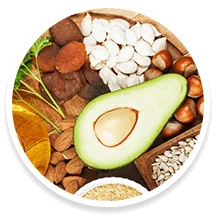
What is vitamin E and why does hair care mention it?
Vitamin E is the body's main fat-soluble antioxidant, guarding the fatty layers of cell membranes against a process called lipid peroxidation. Every day, ordinary metabolism, sun exposure and pollution generate reactive molecules that can damage the fats in cell walls; vitamin E neutralises them before they spread. In the scalp, which is skin, this membrane-protecting role is the most defensible reason the nutrient appears in hair formulas. It is a housekeeping antioxidant, not a growth stimulant, and framing it that way keeps expectations realistic.
What does the evidence actually show for vitamin E and hair?
The honest position is that direct evidence for vitamin E improving hair is limited and preliminary. One small 2010 study in Malaysia reported that a tocotrienol form of vitamin E was associated with an increase in hair number over eight months, compared with placebo. It is an encouraging signal, but it is a single small trial, it used tocotrienols rather than common alpha-tocopherol, and it has not been widely replicated. Vitamin E is better understood as a supporting antioxidant nutrient than a demonstrated hair-growth agent, and any product promising regrowth from vitamin E alone is overselling the science.
| Claim about vitamin E for hair | Evidence strength | Honest read |
|---|---|---|
| Acts as an antioxidant in scalp tissue | Well established | Its core, accepted biological role. |
| Supports the scalp's lipid barrier | Plausible | Consistent with its fat-soluble chemistry. |
| Directly increases hair count | Weak / preliminary | One small trial; not replicated at scale. |
| Reverses genetic hair loss | No evidence | Not a treatment for any condition. |
How does vitamin E work as an antioxidant for the scalp?
Vitamin E protects hair-related cells by donating an electron to unstable free radicals, stopping the chain reaction that would otherwise damage membrane fats. Because it is fat-soluble, it sits exactly where that damage happens — inside the lipid bilayers of cells and in the sebum on the skin's surface. Oxidative stress has been observed in the scalp tissue of some people with pattern hair loss, which is why researchers are curious about antioxidants here. Curiosity is not confirmation, though: the antioxidant logic is sound, but the clinical payoff for hair specifically remains unproven.

Why does Abundant pair vitamin E with vitamin C?
Vitamin E and vitamin C are a classic antioxidant partnership because they defend different parts of the same cell. Vitamin E is fat-soluble and guards the fatty membranes; vitamin C is water-soluble and works in the watery interior. Crucially, when vitamin E neutralises a free radical it becomes temporarily spent, and vitamin C can help regenerate it back to its active form — a recycling relationship well described in nutrition science. That is the thinking behind including both rather than a lone high dose of either. Abundant uses this pairing inside a broader blend, alongside biotin, zinc, vitamin A, pantothenic acid, iodine, selenium and botanicals such as saw palmetto and horsetail.
See the exact vitamin E dose in Abundant →
How much vitamin E do you actually need?
Adults need about 15 mg of alpha-tocopherol a day, an amount most people reach through ordinary food. Vitamin E is abundant in sunflower seeds, almonds, hazelnuts, peanuts, avocado, spinach and vegetable oils, so a varied diet rarely leaves a gap. This matters for hair: because deficiency is uncommon, taking large extra doses is unlikely to help a well-nourished person and can carry risk. The sensible target is adequacy, which is why a hair supplement should supply a modest, food-level amount rather than a mega-dose.
| Food | Approx. vitamin E | Everyday portion |
|---|---|---|
| Sunflower seeds | ~7.4 mg | 1 oz (28 g) |
| Almonds | ~6.8 mg | 1 oz (28 g) |
| Sunflower oil | ~5.6 mg | 1 tbsp |
| Avocado | ~2.1 mg | half fruit |
| Spinach (cooked) | ~1.9 mg | half cup |
Figures are approximate and for general education only; the adult daily target is roughly 15 mg alpha-tocopherol.
Can you take too much vitamin E?
Yes — more is not better, and high-dose vitamin E carries real downsides. Because the vitamin has a mild blood-thinning effect, large supplemental doses can raise bleeding risk, and some studies of high-dose supplementation have raised other safety questions. Health authorities set a tolerable upper intake level of 1,000 mg a day from supplements for adults, far above what food provides. The practical takeaway: skip the giant single-nutrient pills, because a food-level amount within a balanced formula covers the antioxidant base without the risk. If you take blood thinners or have a bleeding disorder, talk to a clinician first.
Vitamin E, at a sensible dose
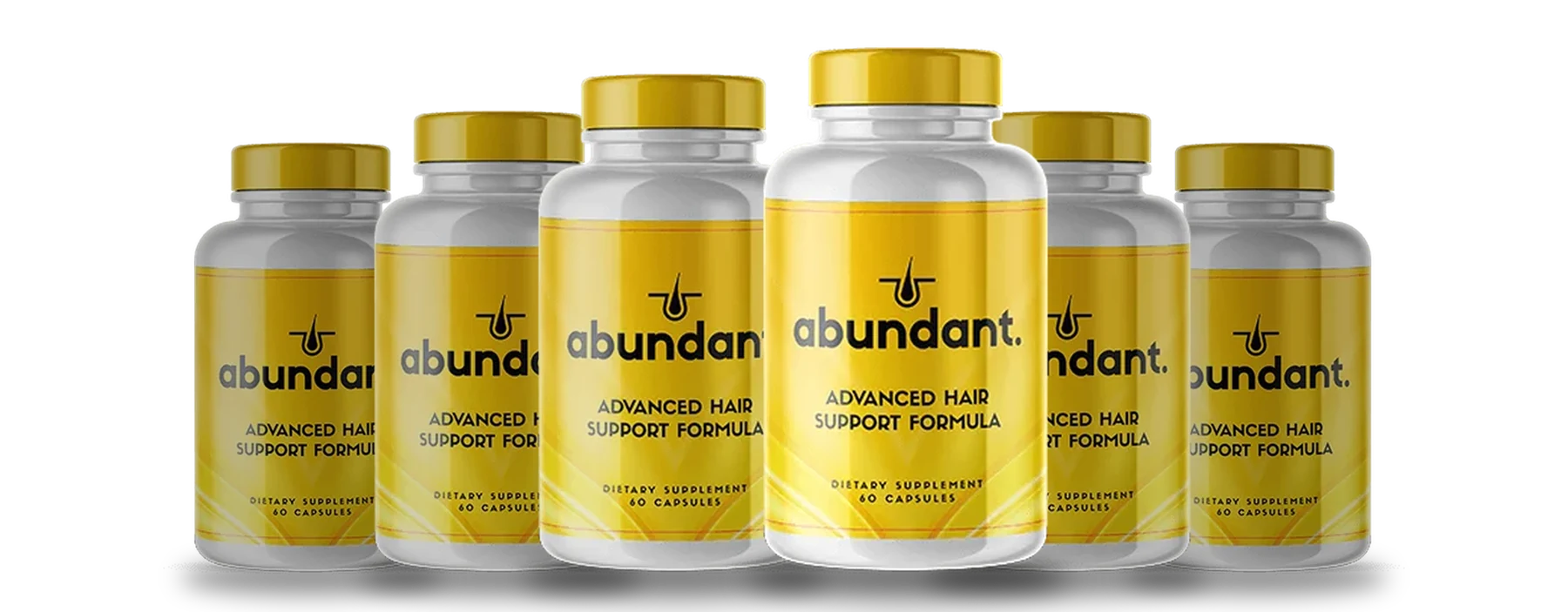
Abundant is a once-daily capsule that pairs a food-level amount of vitamin E with vitamin C, biotin, zinc and other hair-focused nutrients. The six-bottle bundle is the best value at $49 per bottle, with free U.S. shipping and a 60-day guarantee.
Check today's Abundant pricing — from $49/bottleShould you get vitamin E from food, topical oil, or a supplement?
Each route to vitamin E answers a different question, and none is a hair cure. Food is the foundation and the safest source: nuts, seeds, oils and greens supply it alongside other nutrients follicles rely on. Topical vitamin E oil is popular for shine and may help hair feel smoother, but the evidence that it changes growth is thin, and undiluted oil can irritate sensitive skin. A supplement is simply a convenient way to guarantee a food-level amount on busy days. Our guide to biotin for hair growth covers another much-discussed hair nutrient with the same honest lens.

Where does vitamin E fit in a realistic hair routine?
Vitamin E belongs in the supporting cast of a hair routine, not the lead role. The foundation is a varied, protein-rich diet that also supplies iron, zinc and the key vitamins; on top of that sit gentle habits — limited heat and tension, sun protection, decent sleep and stress management. A supplement such as Abundant is the convenient top-up that covers the nutrient base, taken with a meal so the fat-soluble vitamins are well absorbed. No single ingredient carries the outcome; consistency across the whole routine does.
The bottom line
Vitamin E is a genuine, useful antioxidant that protects the fatty parts of scalp cells from oxidative stress — and that is the honest extent of its established role in hair. Direct regrowth evidence is limited, deficiency is rare, and high doses carry risk, so the smart move is food-level adequacy inside a balanced routine. That is precisely how Abundant uses it: a modest amount paired with vitamin C and other hair nutrients, as a partner to good food and gentle care rather than a miracle in a bottle.
Vitamin E is one of two fat-soluble vitamins on most hair labels, and the pair behave differently enough to be worth reading together. Vitamin A for hair and scalp covers the other one, including the reason its upper limit matters more than its lower one — a caution that applies to any fat-soluble nutrient you take daily.
Frequently asked questions
What does vitamin E do for hair?
Vitamin E is a fat-soluble antioxidant that helps protect the fats in cell membranes, including those of the scalp, from oxidative stress. That antioxidant role is its best-understood function. Claims that it directly regrows hair are not well established, so vitamin E is best seen as one supporting nutrient among several, not a standalone hair treatment.
Is vitamin E deficiency a common cause of hair problems?
No. Frank vitamin E deficiency is rare in healthy adults because the vitamin is widespread in nuts, seeds, vegetable oils and leafy greens. It is mainly seen in people with fat-malabsorption conditions. For most people the goal is adequacy, not megadoses, and more is not automatically better.
Should I take a vitamin E supplement for hair?
For most people a varied diet already supplies enough vitamin E, and high-dose single supplements are not recommended without a reason. A modest, food-level amount within a broader hair blend such as Abundant is a more sensible way to cover the base than a large stand-alone dose.
Why does Abundant pair vitamin E with vitamin C?
Vitamin E works in the fatty parts of the cell while vitamin C works in the watery parts, and vitamin C can help regenerate used vitamin E. Pairing the two is a common antioxidant strategy, which is why Abundant includes both alongside biotin, zinc and other hair-focused nutrients.
Can too much vitamin E be harmful?
Yes. Very high doses of supplemental vitamin E can increase bleeding risk and have been linked to other concerns in some studies, which is why an upper limit exists. Sticking to food-level amounts, like those in a balanced hair formula, avoids that issue. Speak to a clinician before taking high-dose vitamin E, especially on blood thinners.
How long before vitamin E might help hair?
Hair grows slowly, roughly a centimetre a month, so no nutrient shows results overnight. If vitamin E plays a supporting antioxidant role, the effect is gradual and only meaningful as part of consistent overall nutrition and gentle hair care over several months. Individual results vary.
Try Abundant risk-free for 60 days →
Abundant is a dietary supplement, not a treatment for any medical condition. These statements have not been evaluated by the Food and Drug Administration. This product is not intended to diagnose, treat, cure or prevent any disease. Always consult a qualified healthcare professional about your individual needs.
References & further reading
- National Institutes of Health, Office of Dietary Supplements. Vitamin E — Fact Sheet for Health Professionals. ods.od.nih.gov/factsheets/VitaminE-HealthProfessional
- Beoy LA, Woei WJ, Hay YK. Effects of tocotrienol supplementation on hair growth in human volunteers. Trop Life Sci Res. 2010. pubmed.ncbi.nlm.nih.gov/24575202
- National Institutes of Health, Office of Dietary Supplements. Vitamin C — Fact Sheet for Health Professionals. ods.od.nih.gov/factsheets/VitaminC-HealthProfessional
- Trüeb RM. Oxidative stress in ageing of hair. Int J Trichology. 2009. Trüeb 2009, Int J Trichology — PubMed 20805969
- Harvard T.H. Chan School of Public Health, The Nutrition Source. Vitamin E. nutritionsource.hsph.harvard.edu/vitamin-e
These references describe nutrients in general terms and do not constitute evidence that any product treats, cures or prevents any condition.
Keep reading: biotin for hair growth · best foods for healthy hair · back to the Abundant blog · homepage.